The Best Indoor Dog Park Flooring: Turf vs. Rubber vs. Epoxy

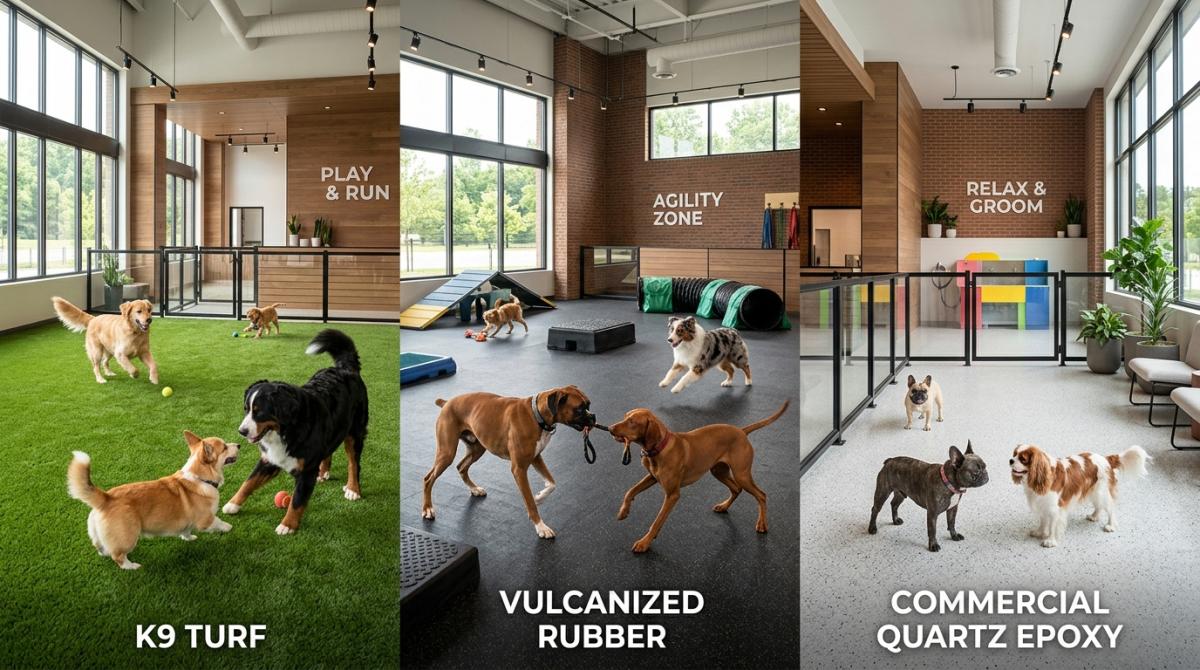
Table Of Contents
When launching or renovating an indoor dog park, operators focus heavily on branding, lighting, and community events. However, veteran facility managers will tell you that the single most critical decision you will make one that directly dictates your business survival, veterinary safety record, and monthly balance sheet—is what lies beneath the paws.
Indoor dog park flooring is not merely a design choice. It is a high-stakes engineering decision. It must withstand the dynamic impact of running 100-pound dogs, resist the corrosive chemistry of canine urine, offer sufficient traction to prevent musculoskeletal tears, and remain easy to sterilize to block zoonotic disease transmission.
In this in-depth guide, we evaluate the three major contenders in commercial pet flooring: K9-Specific Artificial Turf, Sealed Vulcanized Rubber, and Commercial Epoxy Coatings. We compare their performance under the heavy demands of commercial use, detailing their orthopedic safety, biosecurity metrics, odor mitigation profiles, and 10-year lifecycle costs.
The Core Contenders at a Glance
Before diving into the detailed mechanical properties of each flooring type, review this high-level summary of their primary trade-offs:
| Flooring Type | Avg. Installed Cost (sq. ft.) | Orthopedic Safety | Sanitation Grade | Odor Resistance | Est. Lifespan |
|---|---|---|---|---|---|
| K9 Artificial Turf | $13.00 – $25.00 | Excellent | Fair | Poor to Fair | 5 – 8 Years |
| Sealed Vulcanized Rubber | $6.00 – $12.00 | Excellent | Good | Good | 8 – 12 Years |
| Commercial Quartz Epoxy | $7.00 – $15.00 | Poor | Excellent | Excellent | 10 – 15+ Years |
Key Performance Metrics
The graph below rates each flooring material across four critical operational factors on a scale from 1 (lowest) to 10 (highest). This illustrates the distinct strengths of each option: K9 Turf leads in natural aesthetics, sealed rubber excels in joint safety and traction, and commercial epoxy leads in cleanability and durability.
Flooring Comparison: Performance Ratings (Scale 1-10)
Flooring Comparison: Performance Ratings (Scale 1-10)
K9 Artificial Turf
1. K9-Specific Artificial Turf: The Dog's Choice
Artificial turf is the gold standard for creating an immersive, outdoor-like aesthetic. In high-density urban areas like New York City Indoor Dog Parks, clients pay a premium to give their dogs the sensation of playing on real grass. However, commercial turf systems require highly specialized designs to succeed indoors.
The Anatomy of K9 Turf
Standard residential landscaping turf will quickly fail in a commercial indoor dog facility. Commercial dog park turf must feature:
- Polyethylene Blades: Soft and non-abrasive to protect paw pads from friction burns, woven with antimicrobial agents.
- Max Flow or Permeable Backing: The turf backing must be completely porous (preferably a knit backing rather than polyurethane coatings with punched drainage holes) to allow urine to drain immediately.
- Under-Turf Drainage Grid: The turf is installed over interlocking polymer grids (such as AirDrain) that raise the turf 1 inch off the concrete base, allowing liquids to drain freely beneath the turf to a sloped floor and drain channels.
- Non-Porous Infills: Standard silica sand is a disaster for dog parks; it acts like a sponge, absorbing urine and breeding bacteria. Instead, K9 turf requires acrylic-coated round sand (e.g., Envirofill) or natural volcanic zeolite, which prevents ammonia gas from forming.
The Benefits of K9 Turf
- Psychological & Elimination Instincts: Dogs instinctively recognize grass-like textures. This makes turf highly effective at encouraging dogs to eliminate in designated areas rather than on walls or doors.
- Superior Play Comfort: The turf blades combined with infill provide excellent joint cushioning, reducing fatigue and joint impact during high-speed play.
- High Aesthetic Value: Visual appeal is unmatched. A lush green indoor field creates social-media-friendly environments that attract customers.
The Challenges of K9 Turf
- Extreme Odor Risk: Urine that bypasses the turf can pool on the subfloor if the concrete base isn't pitched correctly (at least a 1.5% to 2% slope to a floor drain). Without a dedicated, automated flushing system under the turf, ammonia gas (NH3NH3) will accumulate, overloading the facility's HVAC system.
- Difficult Pathogen Eradication: Turf fibers, backing, and infill create vast surface areas where micro-organisms can build protective biofilms. Sanitizing turf requires flushing large volumes of water mixed with specialized enzymatic or bacterial-digesting cleaners, making it hard to maintain complete sterile conditions compared to solid surfaces.
- Prohibitive Installation Cost: K9 turf is the most expensive option. Turf material, polymer drainage tiles, concrete grading, perimeter securement, trench drains, and professional labor push initial costs to 13.00to13.00to25.00 per square foot.
Operating Tip: If you are building a dog park in a region with high HVAC demands, check out our guide on how to start an indoor dog park for details on sizing ventilation systems to combat turf-based humidity and odor.
2. Sealed Vulcanized Rubber: The Orthopedic Specialist
Sealed vulcanized rubber flooring is highly favored by professional agility trainers (APDT) and hybrid dog daycares. Formulated from high-density rubber (frequently recycled tire crumb combined with EPDM granules), it offers unmatched joint protection.
The Pitfalls of Standard Gym Rubber
Many operators buy cheap interlocking gym mats to save on start-up capital. This is a critical mistake. Standard gym rubber is porous and acts as a massive sponge for liquid waste. Over time, urine penetrates deep into the rubber, creating permanent odor reservoirs and bacterial hazards.
For indoor dog parks, you must install non-porous, vulcanized rubber. This material undergoes high-pressure heat treatment during manufacturing to seal the microscopic pores. The seams must also be cold-welded or sealed with a heavy-duty polyurethane adhesive to prevent liquid from seeping underneath the mats.
The Benefits of Vulcanized Rubber
- Exceptional Shock Absorption: Rubber provides excellent impact protection. It absorbs force, protecting growing puppies and senior dogs from joint strains and bone stress.
- Unrivaled Traction: With a high coefficient of friction, rubber prevents slips even when wet. This makes it an ideal flooring choice for high-speed play, preventing painful cruciate ligament (ACL/CCI) tears and conditions like IVDD in dogs.
- Sound Dampening: Barking dogs in an enclosed space can easily reach 100+ decibels. Rubber absorbs acoustics, creating a much calmer and safer environment for staff and dogs.
The Challenges of Vulcanized Rubber
- Abrasive Properties: While high traction is great for safety, extremely dense rubber can be highly abrasive on paw pads. High-speed running can cause painful friction burns, tears on dogs' paw pads, and exacerbate issues like dog paw yeast infections.
- Vulnerability at the Seams: If roll rubber or tiles are not perfectly sealed at the seams, urine will seep under the mats. Once liquid waste gets trapped beneath rubber flooring, it is nearly impossible to disinfect without removing the entire installation.
- Chemical Sensitivity: Rubber is sensitive to strong chemicals. Harsh oxidizers like chlorine bleach will degrade rubber over time, causing it to crumble. Cleaning must be performed using neutral pH disinfectants, which limit your sanitation options.
Note on Risk Management: Because of the unique safety and health concerns related to paws and joints, ensuring you have the right dog daycare business insurance is critical before selecting your flooring material.
3. Commercial Epoxy Coatings: The Biosecurity Shield
For operators prioritizing hygiene and disease prevention above all else, commercial epoxy coatings are the undisputed gold standard. Often used in veterinary hospitals, boarding kennels, and premium indoor facilities like Chicago Indoor Dog Parks, epoxy offers a completely impervious barrier.
🌧️ Extreme Weather Dog Safety & Indoor Play Guide
Don't let scorching summer pavement or freezing winter storms compromise your dog's physical health and mental happiness. Get our comprehensive survival guide delivered instantly.
Why Grit Size Matters
A smooth, glossy epoxy floor is a recipe for disaster. Active dogs running on wet, smooth epoxy will slip, slide, and suffer severe muscle and ligament tears.
To make epoxy safe for dogs, installers must broadcast an aggregate—typically quartz sand or aluminum oxide grit into the wet epoxy layer, followed by a chemical-resistant topcoat (urethane or polyaspartic). This aggregate must be sized correctly:
- Too coarse: It will act like sandpaper, tearing dog paw pads.
- Too fine: It will fill with water and dirt, losing its slip resistance.
- The Sweet Spot: A double-broadcast of colored quartz aggregate (typically 40-mesh size) provides a textured, slip-resistant surface similar to orange peel.
The Benefits of Epoxy Flooring
- 100% Smooth Biosecurity: Epoxy is applied as a liquid that cures into a smooth solid plastic layer. It leaves no cracks, joints, or pores where viruses like Parvovirus, bacteria like Leptospira, or parasites like Giardia can hide.
- Ultimate Cleanability: Epoxy is incredibly easy to clean. Operators can pressure wash, foam, and squeegee waste directly into floor drains. It is fully compatible with strong disinfectants, including bleach and veterinary-grade virucides.
- Outstanding Durability: Unlike turf or rubber, epoxy cannot be shredded by claw scratching or chewed on by anxious dogs. A high-quality polyaspartic topcoat can last over 15 years with minimal maintenance.
The Challenges of Epoxy Flooring
- Hard and Rigid Surface: Epoxy is applied directly over concrete and has zero flexibility. Dogs playing on epoxy face high skeletal impact, which can lead to joint fatigue, arthritis flare-ups, and early exhaustion.
- Acoustic Echo Chamber: Concrete coated with epoxy reflects sound waves, creating a loud echo chamber that amplifies barking. This can increase stress levels for both dogs and staff.
- Extensive Surface Preparation: Installing epoxy requires perfect concrete prep. The concrete base must be shot-blasted or diamond-ground to create a profile for the epoxy to bond to. Any sub-slab moisture will cause the epoxy to bubble and peel, requiring a moisture vapor barrier.
Deep-Dive Comparison: Crucial Factors for Dog Parks
Choosing the best flooring option requires analyzing how these materials compare across key operational and health categories:
A. Orthopedic Health & Joint Safety
According to veterinary orthopedic experts, a dog's physical safety during active play is highly dependent on flooring flexibility and grip. Slipping is a major cause of soft-tissue injuries, which is why organizations like the Veterinary Orthopedic Society (VOS) study substrate impact.
- Rubber provides the highest safety profile, offering natural compression under foot and excellent traction.
- Turf is a close second, as long as it is paired with a quality drainage backing and appropriate infill depth to absorb impact.
- Epoxy is the hardest option. Even with quartz grit, it offers no cushioning. Extended play on epoxy can lead to sore joints and fatigue.
B. Biosecurity & Disease Management
Following biosecurity protocols similar to the American Animal Hospital Association (AAHA), indoor dog parks host dogs from various environments, creating a high risk for infectious disease transmission.
- Epoxy provides the best biosecurity. It is non-porous and smooth, making it highly effective at preventing the spread of canine parvovirus, Giardia, and kennel cough.
- Rubber is moderately easy to disinfect, but any failure in seam seals can lead to bacterial growth underneath the mats.
- Turf is the most difficult to sterilize. Disinfectants must penetrate dense thatch layers and infill sand, making it hard to eliminate pathogens completely.
C. Odor Mitigation & Air Quality
In line with EPA indoor air quality guidelines, mitigating ammonia buildup from dog urine is a major priority for indoor facilities, as it directly affects customer satisfaction and respiratory health.
- Epoxy does not absorb odor. Urine can be quickly squeegeed away, keeping odor levels low.
- Rubber resists odor well, provided it is non-porous and the seams remain sealed.
- Turf has the highest risk of retaining odors. If urine gets trapped in the backing or infill, it will cause persistent odor issues, requiring extensive flushing and enzyme treatments.
D. Startup Budget vs. Lifecycle Cost (ROI)
While upfront costs are important, operators must also consider the long-term durability and maintenance expenses of each flooring type.
- Epoxy requires a high initial investment (7−7−15/sq. ft.) but offers the longest lifespan (10 - 15+ years) with very low maintenance costs, making it highly cost-effective over time.
- Rubber offers a balanced approach, with moderate initial costs (6−6−12/sq. ft.) and a long lifespan of 8 to 12 years.
- Turf has the highest total cost of ownership. It requires expensive initial setup (13−13−25/sq. ft.) and typically needs to be replaced every 5 to 8 years in high-traffic commercial spaces.
The Hybrid Strategy: The Industry's Best-Kept Secret
Faced with these trade-offs, successful operators in dog-heavy states like California Dog Parks and Texas Dog Parks rarely choose just one flooring material. Instead, they use a hybrid zoning strategy to capitalize on the strengths of each material:
- The Potty Zone (K9 Turf): Install artificial turf over a sloped concrete base with built-in flushing lines in a dedicated "potty zone." This encourages dogs to eliminate on a familiar grass-like surface, keeping waste concentrated in one easy-to-flush area.
- The Active Play Zone (Sealed Rubber): Use sealed vulcanized rubber in main play areas. This gives dogs the traction and impact protection they need for running, jumping, and chasing, preventing slips and joint strains.
- The High-Traffic & Utility Zones (Quartz Epoxy): Use smooth quartz epoxy in reception areas, grooming rooms, containment gates, and corridors. These areas see the highest wear and tear from foot traffic and require frequent cleaning, making epoxy the perfect choice.
By zoning your facility, you can optimize joint safety, sanitation, and odor control while managing your overall flooring budget.
Frequently Asked Questions (FAQ)
Is epoxy flooring too slippery for dogs?
Smooth epoxy is very slippery and dangerous for active dogs. However, commercial epoxy floors with a double-broadcast of quartz sand or aluminum oxide aggregate provide excellent slip resistance, even when wet.
Can you use standard landscaping artificial turf indoors?
No. Landscaping turf is not designed for the drainage needs of a dog park. It lacks the antimicrobial properties, fast-draining backing, and high-performance infills required to manage heavy dog waste and prevent odors indoors.
How do you clean and sanitize indoor dog turf?
Cleaning turf requires a multi-step process: solid waste must be removed immediately, followed by daily flushing with water and specialized enzymatic or bacterial cleaners to break down urine. Weekly deep-cleaning with a turf vacuum or scrubber is recommended.
How long does rubber flooring last in a busy dog park?
High-quality, sealed vulcanized rubber rolls or interlocking tiles can last 8 to 12 years in busy commercial environments, provided they are properly maintained and cleaned using rubber-safe, neutral pH disinfectants.
Which flooring is best for large dogs?
For large, heavy dogs, sealed vulcanized rubber is ideal because it provides the best joint impact protection and high durability against deep claw scratches, whereas epoxy can cause joint soreness and turf can wear down faster under heavy paws.